

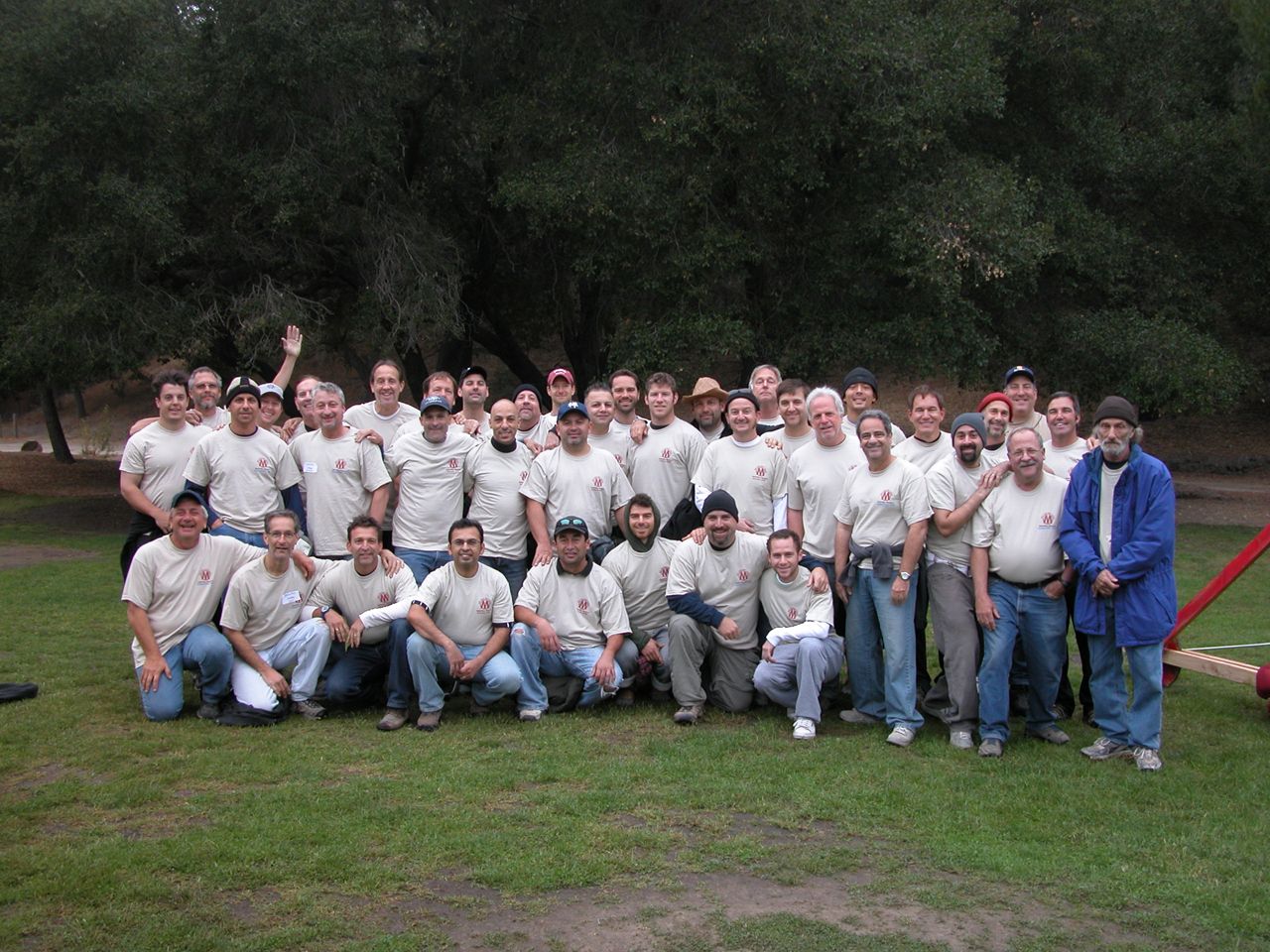
Photo: September, 2008
Guest post by Marcus Henry, one of the men I’ve had the privilege of working with for over 15 years.
—
I called Wayne Levine on a weekday afternoon because I’d read his book and something in it wouldn’t leave me alone.
I’d been through the lists. The Art of Manliness. Various titles that told me what real men do: build fires, hold their liquor, change their own oil. Wayne’s book was different. It wasn’t a list. It pointed inward. It said the work was mine to do, and it had been sitting unfinished for a long time.
So I found his website. And on that website, there was a photo (see above).
A bunch of white men in the woods in California.
I grew up in the South. You understand why I paused.
I called him anyway. He answered, told me a little about the weekends, and said: why don’t you just come check it out? I drove to Camp Whittier, outside Santa Barbara, not entirely sure I was making a good decision. That was 2010. I’ve been doing the work ever since.
The Marine Corps taught me to stay ready. That lesson started before boot camp. It started in the Apostolic Faith Church in Columbus, Georgia, where we were taught to be vigilant for Christ’s return. If you weren’t right with God when He came back, you got left. So you stayed ready. You stayed watchful. You never fully relaxed.
The Marine Corps didn’t install that in me. It just gave it a uniform.
Boot camp confirmed what I already believed: discipline lives in the small things. Make the bed. Shave every day. Put your gear where it belongs so you can find it in the dark. Stay sharp in the small choices and you’ll be sharp when it counts. I believed this completely. I still believe parts of it.
But I carried something else out of those years. A low hum of hypervigilance that never fully turned off. Exits. Sight lines. My back to the wall. In a restaurant, on an airplane, at my kids’ school performances. It wasn’t anxiety. It was readiness. I told myself there was a difference.
The problem with never fully standing down is that it keeps you at a distance from the people who need you close.
My mother died in 2007. I had talked to her the night before. She called asking for help with her computer. I was just sitting down to dinner, told her I’d call in the morning, and told her I loved her. She died that night at that computer. I blamed myself.
I wore my dress blues to the funeral. I stood straight. I kept my face still. I slid one of my original dog tags into her palm as she lay in her casket, turned and walked back to my pew. I was a Marine. Marines don’t fall apart in public.
The preacher spent most of the service trying to win souls for Christ. I sat there angry, dry-eyed, and somewhere inside me a door closed quietly.
I didn’t grieve. I moved.
Three years later, at a men’s weekend at Camp Whittier, we did an exercise built around anger. It’s simple. The men hold you down. You try to get up.
I didn’t expect what happened next.
I started fighting to stand up. Then something shifted. I stopped fighting. My body went limp and I started crying. The kind of crying that comes from somewhere you haven’t been in years. I knew exactly where it was coming from. The funeral. The uniform. The door that had closed.
I didn’t have to explain it. The men stopped the exercise. They didn’t step back. They moved closer. They picked me up and circled around me. They held me up as I wept.
I had been in a brotherhood before. The Marine Corps. The Masons. Men who would show up in a crisis, men I’d trust with my life. But I’d never been in a room where breaking down was met with that kind of response. Where the falling apart was the point, not a failure of it.
That was new.
A man named Chris told me early in the work: the thing you don’t want to bring to the men is exactly the thing you need to bring. Not just for yourself. Because there are other men in that room carrying the same thing, waiting for someone else to say it first.
I have tested that theory many times. He has never been wrong.
Over the years, through military moves, a divorce, rebuilding, co-parenting, the work was the constant. Different zip codes, different time zones, same call every week. The men changed some over the years, some familiar faces, some new ones, but the work stayed the same. Wayne used to say: if I told you I’d give you a million dollars to make this call, you’d make it. So what does it say about your commitments when a scheduling conflict suddenly feels like a reason to disappear? The work taught me to be honest about my priorities. If something genuinely ranked higher, you handled it and came back. But most of the time the thing pulling you away didn’t rank higher. You just let it feel like it did.
I showed up. Not perfectly. But consistently.
And every time I did, something got lighter.
I used to think having a system for everything was the same as being a good father. Everything in its place. Shoes in the closet, same spot, every time. I’d find them for her in two seconds and I’d let her feel it. My daughter looked me in the eye and said: I feel like you’re shaming me.
She wasn’t wrong.
That moment had nothing to do with discipline. It had everything to do with needing things done my way and making her pay for it when they weren’t. The Marine Corps gave me systems. The men’s work taught me to notice when my systems were working on the people I loved instead of for them.
The Marine Corps taught me to make the bed perfectly. The men’s work taught me to lie in it messy. To sit with discomfort instead of solving it. To be present instead of prepared.
I still think discipline matters. I still make my bed every day. But I’ve come to understand that discipline without a safe place to land is just control looking for a reason.
The men’s work gave me somewhere to land.
My daughters are 12 and 14. When I show up for them, I’m trying to show up like the person I’d want them to marry someday. That’s the only framework I need. It doesn’t tell me what to do in every situation. It tells me who to be. Patient, kind, supportive, but with boundaries. That context came out of a men’s weekend in California, in the middle of an exercise I didn’t understand, in a room full of men I’d initially been afraid to trust.
Earnestine knew me as the boy who left for the Marines and made her proud. She never got to meet the man who came after. The one who cries when he needs to, who walks his daughter back to her room after a nightmare, lays her down, and rubs her hair until she falls back asleep, who drove to California to sit around a fire in the woods with strangers and finally came home.
I think she’d be okay with it.
—
You can follow Marcus and read more of his writing at Marcus’ website here

His writing comes from those places: the Marines, the work, fatherhood, and the practice of showing up.
You can find his other essays at marcushenry.com
- Welcome to a Man’s World - August 28, 2026
- Wayne’s Million Dollar Question - May 14, 2026
- What a Marine Learned About Asking for Help - April 13, 2026